
Berlin Audio Guide: Stories Behind the Wall, Reichstag & Beyond
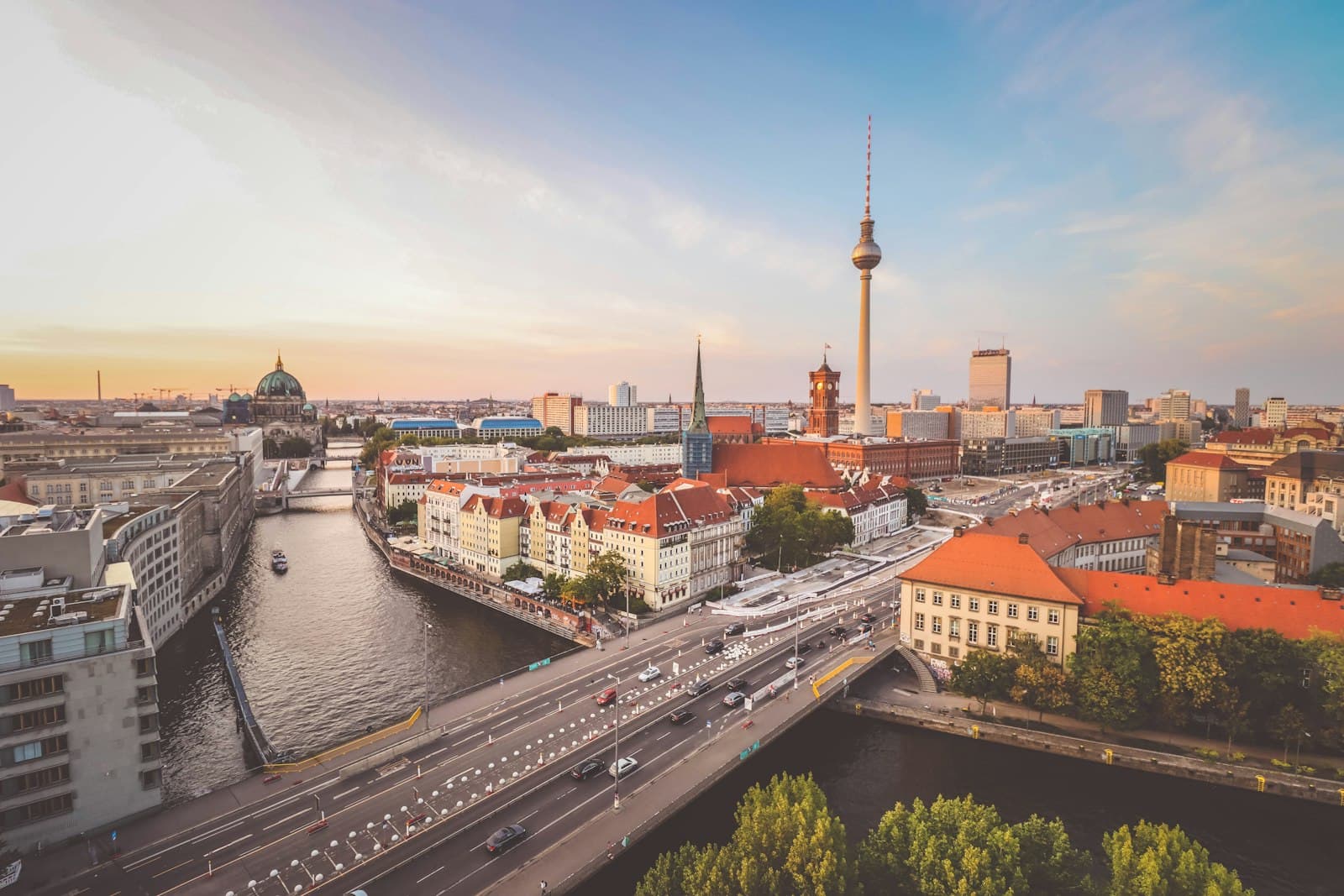
A Berlin audio guide transforms a walk through the city into a journey through some of the most dramatic stories of the 20th century. Instead of reading plaques and checking Wikipedia, you hear about the people who lived, escaped, protested, and rebuilt — right at the places where it happened. Here's a preview of the stories waiting for you at five of Berlin's most important stops.
Why Berlin is the perfect city for an audio guide
Some cities are pretty. Berlin is a story. Almost every street corner in the center carries the weight of history — empire, revolution, war, division, reunification, and reinvention. But the problem with Berlin's history is that much of it is invisible. The Wall is mostly gone. Bombed buildings were rebuilt or replaced. The stories are there, layered under the surface, but you need someone to tell them to you.
That's what makes an audio guide so powerful here. Standing at the Berlin Wall Memorial, you don't just see a stretch of concrete — you hear about the tunnel dug by students to rescue their families. At the Reichstag, you don't just admire the glass dome — you learn why its architect insisted on transparency in the building that houses German democracy. The stories change how you see the city.
Travee's AI-powered audio guide for Berlin draws on deep research and local knowledge to tell these stories in a way that feels like walking with a knowledgeable friend, not listening to a lecture. Here's a taste of what you'll hear.
Stop 1: The Berlin Wall + East Side Gallery
You're standing at the East Side Gallery, the longest remaining section of the Berlin Wall — 1.3 kilometers of concrete canvas covered in murals. But before the paint came the terror.
The Berlin Wall went up overnight on August 13, 1961. Berliners woke up to find barbed wire cutting through their streets, separating families, friends, and lovers. Within days, the wire became concrete. Within months, the death strip — a no-man's-land of watchtowers, dogs, and shoot-to-kill orders — made crossing one of the most dangerous acts imaginable.
And yet people tried. Over 5,000 succeeded. They escaped in car trunks, homemade hot air balloons, through tunnels, inside hollowed-out surfboards, and even on a zip line strung between apartment buildings. Some of the most extraordinary escapes happened right here, along the Spree. In September 1962, a group of 29 people crawled through a tunnel — later known as Tunnel 29 — that began in a building on the eastern side near Bernauer Straße. On June 8, 1962, thirteen East Berliners, including a baby, hijacked the excursion boat Friedrich Wolf near the Osthafen and sailed it across the Spree to freedom.
After the Wall fell on November 9, 1989, artists from around the world were invited to transform the eastern side into a gallery. Dmitri Vrubel's Brotherly Kiss — showing Soviet leader Brezhnev and East German leader Honecker in an embrace — became its most iconic image. Vrubel based it on an actual photograph from 1979 and added the caption: "My God, Help Me to Survive This Deadly Love."
The audio guide takes you along the full stretch, stopping at the most significant murals and the spots where escapes were attempted, telling the stories the paint covers up.
Stop 2: The Reichstag
The Reichstag is one of the most symbolically loaded buildings in the world. Built in 1894 for the German Empire's parliament, its history reads like a compressed novel of the 20th century.
On February 27, 1933, the Reichstag burned. A young Dutch communist named Marinus van der Lubbe was found inside and arrested. The Nazis, just one month in power, used the fire as a pretext to suspend civil liberties — the Reichstag Fire Decree effectively ended democracy in Germany and paved the way for Hitler's dictatorship. Historians still debate whether van der Lubbe acted alone or was set up. He was executed in January 1934. He was 24 years old.
The building sat in ruins for decades. After the war, it ended up in West Berlin but right against the Wall — a shell of a parliament in a divided city. It wasn't until reunification that the Reichstag was reborn.
British architect Norman Foster won the commission to renovate it, and his glass dome became a powerful statement: the people of Germany can literally look down on their representatives from above. Government as a glass house. The dome is open to visitors, and as you spiral up the ramp, the audio guide explains the Soviet graffiti still preserved on the interior walls — Russian soldiers scrawled their names and messages in 1945 when they took the building. The German parliament deliberately kept them visible as a reminder.
Standing on the roof of the Reichstag, looking out over the Tiergarten and the city skyline, the audio guide connects the dots between the charred ruin of 1933, the Soviet conquest of 1945, and the transparent democracy of today. It's one of Berlin's most powerful moments.
Stop 3: Brandenburg Gate
The Brandenburg Gate has meant something different in every era. Built in the 1790s as a neoclassical symbol of peace, it became a Nazi parade ground, a Cold War no-man's-land, and finally the backdrop for reunification.
During the division, the gate sat in the death strip — visible from both sides, reachable from neither. On June 12, 1987, Ronald Reagan stood near this spot and made his famous demand: "Mr. Gorbachev, tear down this wall." Two years later, on the night of November 9, 1989, jubilant Berliners climbed on top of the Wall right here. The photos of that night — people dancing, crying, spraying champagne on the Wall in front of the illuminated gate — became the defining images of the Cold War's end.
But the story Travee's audio guide tells at the Brandenburg Gate goes beyond the famous moments. It's about a woman named Ida Siekmann, who lived in an apartment building on Bernauer Straße. On August 22, 1961 — just nine days after the Wall went up — she threw her bedding out of her third-floor window, hoping to jump to the western side below. She didn't survive the fall. She was the first person to die trying to cross the Berlin Wall. Her story, and the stories of at least 139 more who died at the Wall, are the human dimension that makes Berlin's history so devastating and so important to remember.
Stop 4: Checkpoint Charlie
Checkpoint Charlie was the most famous border crossing between East and West Berlin — the point where American and Soviet tanks faced each other, barrel to barrel, during the most dangerous moment of the Cold War.
On October 27, 1961, a dispute over border passes escalated into a standoff. Ten American M48 tanks rolled to the checkpoint. Ten Soviet T-55 tanks rolled to meet them. For 16 hours, the two nuclear superpowers stared each other down across a few meters of Friedrichstraße. One wrong move — a nervous gunner, a miscommunication — and the Cold War could have gone hot. The tanks withdrew the next day after back-channel negotiations, but the world had come closer to nuclear war than most people realize.
The audio guide brings you to the exact spot and explains how the crossing worked: the fear of approaching the guards, the paperwork designed to intimidate, the hidden surveillance. You hear about Peter Fechter, a bricklayer who was shot trying to climb the Wall near here in August 1962 — he lay in the death strip, bleeding and calling for help, while guards on both sides watched. He died an hour later. He was 18. His death caused international outrage and remains one of the most haunting events of the Cold War.
Today, Checkpoint Charlie is admittedly touristy — actors in fake uniforms will stamp your passport for a fee. But with the audio guide in your ears, you see through the souvenir shops to the real history underneath.
Stop 5: Bernauer Straße Memorial
Bernauer Straße is where the Berlin Wall's human cost becomes most visceral. This ordinary residential street was split in two overnight in 1961. The buildings on the southern side were in East Berlin; the sidewalk in front of them was in the West. Residents literally looked out their windows into freedom.
In the first days, people jumped from their apartments to the western sidewalk below, while firefighters held rescue nets. As the Wall grew higher and the windows were bricked up, the escapes became more elaborate and more desperate. Tunnels were dug beneath the street — the most famous, "Tunnel 57," ran from a disused bakery on the western side to an outdoor toilet in the East. In October 1964, 57 people crawled through it to freedom.
The memorial today preserves a section of the death strip in its full depth — the inner wall, the outer wall, the raked sand, the watchtower. It's the only place in Berlin where you can truly see the Wall as it was: not one wall but two, with a killing ground in between.
The audio guide walks you through the memorial grounds, stopping at the Chapel of Reconciliation (built on the site of a church the East German government dynamited in 1985 to improve the guards' line of sight) and the Window of Remembrance, where photos of those who died at the Wall are displayed. It tells their stories — not as statistics, but as individuals with names, ages, families, and dreams.
Experience Berlin's stories with Travee
Reading about Berlin's history is one thing. Hearing these stories in your ears while standing in the exact places where they happened is something else entirely. Travee's AI-powered audio guide brings Berlin to life — not as a textbook, but as a narrative that makes you feel the weight and wonder of this extraordinary city.
Put in your headphones, start walking, and let Berlin tell you its story.